


Website Marketing SEO Services for Orthodontists: Why Your Practice Needs a Different Strategy Than the Dentist Next Door
Let’s start with something that almost nobody in dental marketing will tell you straight:
Orthodontic SEO and general dental SEO are not the same thing. Not even close.
Most marketing agencies — even ones that call themselves top dental SEO companies — treat every oral healthcare practice like it’s the same business. Same strategy. Same content templates. Same keyword approach. Plug in the location, swap out the specialty, ship it.
And orthodontists end up paying for campaigns built for a completely different type of practice, wondering why they’re not getting the consultation bookings they were promised.
Here’s the reality: an orthodontic practice operates on a fundamentally different business model than a general dental office. Your patient journey is longer. Your decision-making cycle is more complex. Your primary decision-makers are often parents — not the patient themselves. Your high-value services (braces, Invisalign, clear aligners, retainers) require trust-building over weeks, not days. And your local competition includes not just other orthodontists, but general dentists who’ve added Invisalign to their menu and are actively competing for the same search terms.
A cookie-cutter dental SEO and digital marketing campaign doesn’t account for any of this.
This guide does. This is the exact website marketing and SEO services for orthodontists framework we use at Leads Swiped to fill consultation calendars — built from the ground up around how orthodontic patients actually think, search, and decide.
Let’s get into it.
The Orthodontic Patient Journey: Why It Changes Everything About Your SEO
Before we talk tactics, we need to understand the person we’re marketing to. Because SEO services for orthodontists that don’t start with patient psychology are just expensive guesswork.
Here’s how a typical orthodontic patient journey unfolds in 2026:
🔍 Stage 1 — Awareness (Weeks to Months Before Booking)
A parent notices crowding in their child’s teeth.
An adult finally decides to fix their bite.
A teenager gets referred by their general dentist.
At this stage, they’re researching — not booking.
They’re Googling:
• “When should kids get braces?”
• “How much does Invisalign cost?”
• “Are clear aligners worth it for adults?”
🦷 Stage 2 — Consideration (Days to Weeks Before Booking)
Now they know they want orthodontic treatment.
They’re comparing providers, reading reviews, checking before-and-after photos, and researching Invisalign vs. traditional braces.
Searches become highly specific:
• “Orthodontist near me”
• “Best orthodontist in [city]”
• “Invisalign provider [neighborhood]”
✅ Stage 3 — Decision (Hours to Days Before Booking)
They’ve narrowed down their options.
Now they’re judging your website, your credibility, and how easy it feels to take the next step.
Is your site professional?
Does it feel trustworthy?
Is booking simple?
Do you clearly explain what happens next?
This is where conversion-focused design closes the consultation — or quietly loses it to a competitor.
Why does this matter for website marketing SEO services for orthodontists? Because you need to show up at all three stages with different types of content targeting different searches — not just rank for “orthodontist near me” and call it a day.
A general dentist’s patient journey often collapses into a single stage: “tooth hurts, needs dentist, books immediately.” Orthodontics is a considered purchase. Parents are making decisions that affect their children’s faces and self-confidence for years. Adults are making decisions that will affect their appearance and confidence for the rest of their lives.
Your entire online presence needs to honor that decision weight — and the best SEO agency for dentists and orthodontists will build a strategy around all three stages simultaneously.
The Invisalign Problem: Why You’re Losing High-Value Cases to General Dentists
Here’s a competitive dynamic that’s quietly costing orthodontic practices significant revenue — and most don’t even realize it’s happening.
Over the last decade, Invisalign and similar clear aligner systems have expanded their provider networks aggressively. General dentists can now become certified Invisalign providers with relatively minimal training. And because dental SEO and digital marketing for general practices is often more established (more budget, more agencies, longer track record), general dentists are frequently outranking orthodontists for the very search terms that should belong to specialists.
“Invisalign near me.” “Clear aligners [city].” “Teeth straightening without braces.” These are orthodontic searches that general dental practices are capturing at scale.
The answer isn’t to panic — it’s to compete smarter. Orthodontists have genuine advantages: deeper expertise, more experience with complex cases, full spectrum of treatment options, and the ability to handle cases that general dentists can’t. But those advantages are invisible to Google if your website and content don’t make them explicit.
SEO services for orthodontists that account for this competitive reality will:
- Build dedicated, deeply optimized pages for every treatment you offer — Invisalign, traditional braces, ceramic braces, lingual braces, retainers, surgical orthodontics — each with content that demonstrates specialist-level knowledge
- Create content that explicitly addresses why seeing an orthodontist (versus a general dentist) matters for treatment outcomes
- Target the full spectrum of Invisalign and clear aligner searches with content that outranks generalist providers through depth and specificity
- Build E-E-A-T signals (Experience, Expertise, Authoritativeness, Trustworthiness) that position your practice as the obvious specialist choice versus the general dentist who added aligners as a side service
If your current SEO agency for orthodontists hasn’t mentioned this competitive dynamic — they’re not paying close enough attention to your specific market.
The Complete Website Marketing Framework for Orthodontic Practices
Let’s break down what a full website marketing and SEO services for orthodontists engagement actually looks like — layer by layer.
Layer 1: Your Website as a Patient Conversion Machine
Here’s an uncomfortable truth: for orthodontic practices, your website matters more than it does for almost any other local service business.
Why? Because of that extended consideration stage we talked about. A patient researching orthodontic treatment will visit your website multiple times over days or weeks before deciding to book a consultation. They’ll look at your before/after results. They’ll read about your treatment philosophy. They’ll try to get a feel for whether they’d trust you with their child’s smile.
If your website is generic, slow, outdated, or hard to navigate — they’re gone. To a competitor whose website made them feel confident.
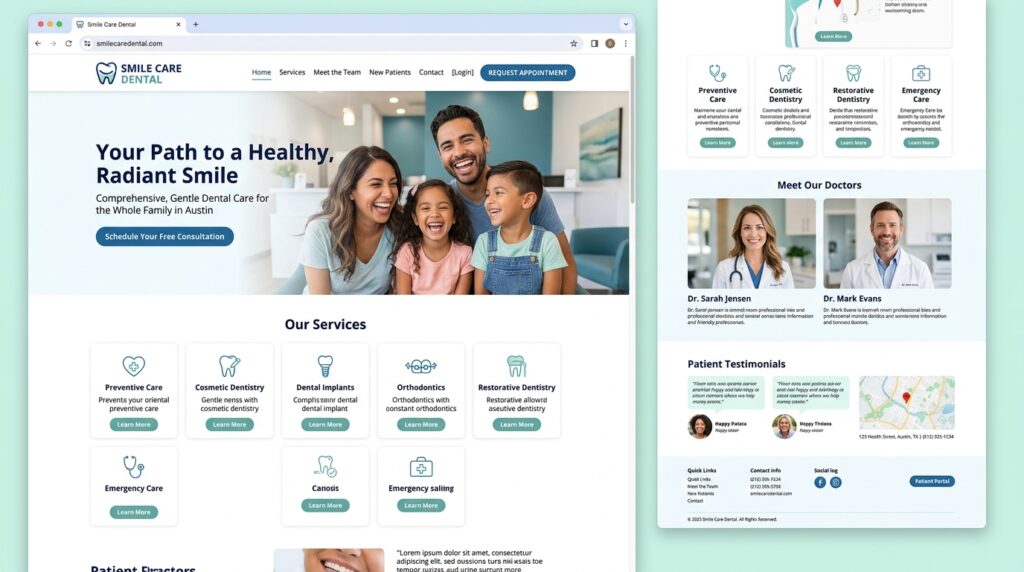
The best SEO company for dental practices working with orthodontists will insist on a website that does all of the following:
Converts on mobile. Over 70% of orthodontic research happens on smartphones. If your consultation request form is clunky, if your before/after photos don’t load properly on mobile, if your phone number isn’t a tap-to-call link — you are hemorrhaging consultations silently.
Showcases actual results. Before/after photo galleries are not optional for orthodontic websites. They’re conversion assets. Real patient results (with consent) are the single most persuasive content on an orthodontic website — more than any written copy. They need to be prominent, load fast, and be properly organized by treatment type.
Clearly explains your process. “What happens at a consultation?” “How long will treatment take?” “What’s the difference between your Invisalign option and what the dentist down the road offers?” Answering these questions on your website doesn’t reduce conversions — it dramatically increases them, because it removes the friction of uncertainty.
Has an irresistible consultation offer. Free initial consultation. Complimentary Invisalign assessment. No-commitment smile evaluation. Whatever your practice offers, it needs to be front and center — not buried in your navigation.
Loads in under 2.5 seconds. On every device. This is both a conversion requirement and a ranking requirement. Google’s Core Web Vitals measure this, and it feeds directly into both your organic rankings and your local search visibility.
Layer 2: Keyword Strategy Built for the Orthodontic Patient Journey
Remember those three stages — Awareness, Consideration, Decision? Your keyword strategy needs to cover all three.
Awareness-stage keywords (educational, high volume, low commercial intent):
- “how much does Invisalign cost”
- “at what age should kids get braces”
- “how long does orthodontic treatment take”
- “Invisalign vs braces pros and cons”
- “signs your child needs an orthodontist”
You’re not going to book consultations directly from these searches. But you will build trust, earn return visits, establish your practice as a knowledgeable authority, and appear in front of parents who are weeks away from being ready to book. This is the top of your funnel — and the top dental SEO companies know how to build content that serves it properly.
Consideration-stage keywords (comparative, medium commercial intent):
- “best orthodontist in [city]”
- “Invisalign provider [city]”
- “orthodontist vs dentist for Invisalign”
- “ceramic braces vs Invisalign [city]”
- “orthodontist reviews [city]”
This is where Local Pack rankings and review volume win or lose the case. Someone searching these terms is actively comparing you to 2–3 competitors. Your GBP needs to be immaculate. Your reviews need to be recent and plentiful. Your website needs to load fast and look trustworthy.
Decision-stage keywords (high commercial intent, lower volume, easiest to convert):
- “orthodontist near me free consultation”
- “Invisalign consultation [city]”
- “orthodontic appointment [neighborhood]”
- “emergency orthodontist [city]”
- “orthodontist accepting new patients [city]”
Whoever ranks for these terms gets the booking. These are the searches of someone who has already decided to move forward — they just need to find the right practice. These terms often have lower competition than broad terms and convert at a dramatically higher rate.
A proper SEO agency for orthodontists builds content and optimization targeting all three stages simultaneously, creating a funnel that catches patients at every point in their decision journey.
Layer 3: Local SEO — Owning Your Map in the Orthodontic Context
Everything about local search that applies to general dentists applies to orthodontists — but with a few important differences.
Your Google Business Profile category matters enormously. Your primary category should be “Orthodontist” — not “Dentist.” This is a surprisingly common mistake. When someone searches “orthodontist near me,” Google heavily favors GBP profiles with the Orthodontist category. If you’re categorized as a general dentist you’re essentially invisible for those searches.
Treatment-specific secondary categories and services. Add “Invisalign Provider,” list every service you offer in the GBP services section (traditional braces, Invisalign, ceramic braces, retainers, teeth straightening, lingual braces, surgical orthodontics). Each service listed is a keyword signal.
Photos that sell the outcome. Before/after photos on your GBP (with consent) are not just trust builders — they’re engagement signals. Users who stop to look at your photos send behavioral signals to Google that your listing is compelling. More engagement = stronger ranking signals.
Reviews with treatment specificity. When you’re generating reviews, subtly encourage patients to mention the specific treatment they received. A review that says “My son’s Invisalign treatment was incredible” is more valuable for Invisalign searches than a generic “Great practice!” review. This is a little-known review optimization tactic that top dental SEO and digital marketing specialists use.
Radius targeting for realistic service areas. Orthodontic patients travel further than general dental patients — they’ll often come from neighboring towns or suburbs for a specialist they trust. Make sure your content targets not just your immediate city but the surrounding communities within your realistic service radius.
Layer 4: Content That Converts the Consideration Stage
The most underutilized content opportunity in SEO services for orthodontists is the comparison and decision-stage content that walks patients through the exact questions they’re already asking.
This isn’t blog content for its own sake. This is strategic content designed to intercept patients mid-decision and give them a reason to choose your practice.
Treatment comparison pages — “Invisalign vs. Traditional Braces: Which Is Right for You?” This is a high-intent search. Someone reading it is actively deciding between treatments and likely within weeks of booking. A thorough, honest comparison that demonstrates your expertise is both a ranking asset and a conversion asset.
Cost and financing pages — “How Much Does Invisalign Cost in [City]?” One of the most-searched orthodontic questions and one of the most avoided by practices worried about scaring patients off. Here’s the reality: people are going to find this information somewhere. If you provide it — honestly, with context about financing options, insurance, payment plans — you earn trust and capture that search traffic. Competitors who refuse to discuss cost lose the search to practices willing to be transparent.
Age-specific content — “Invisalign for Teens: What Parents Need to Know.” “Adult Orthodontics: Is It Too Late to Straighten Your Teeth?” These pages target specific patient segments with high conversion potential and relatively low competition.
Referral and pediatric content — “When Should My Child See an Orthodontist?” targets the exact question parents are Googling before making their first orthodontic appointment. Ranking for this query puts your practice in front of parents at the earliest possible stage in the journey.
Local authority content — “Why [City] Families Choose [Practice Name] for Orthodontic Treatment.” “Top Questions Our [City] Patients Ask About Braces.” Local content builds relevance signals and captures neighborhood-level searches.
Layer 5: Reputation and Trust Signals — The Orthodontic Multiplier
Trust carries more weight in orthodontics than in almost any other local service. Parents are choosing someone to manage multi-year treatment for their child’s smile. Adults are making significant financial and time investments. The trust bar is high.
Your digital trust signals need to match that bar:
Review volume and quality. A minimum of 50 Google reviews to be taken seriously in most markets; 100+ to be competitive; 200+ to be dominant. And not just stars — written reviews that describe positive treatment experiences, friendly staff, flexible scheduling, and great results.
Credentials and associations prominently displayed. Board certification, AAO membership, Invisalign Diamond or Platinum provider status, years of experience. These belong on your homepage, not buried on an about page. They’re E-E-A-T signals that both Google and potential patients use to evaluate trust.
Real team photos and video. Stock photos on orthodontic websites are conversion killers. Parents want to know who will be treating their child. Real photos of your actual team, your actual office, your actual results build the human connection that closes consultations.
Consistent NAP across the web. Every directory listing — Healthgrades, Zocdoc, US News doctor listings, AAO’s find-a-doctor tool, Yelp, local directories — needs your practice name, address, and phone number listed identically. Citation inconsistency is a silent Local Pack suppressor that even the best SEO company for dental practices sometimes overlooks in orthodontic-specific campaigns.
What to Look for in an SEO Agency for Orthodontists
Not every agency that claims to offer SEO services for orthodontists actually understands the orthodontic business model. Here’s your filter:
They understand the multi-stage decision journey. If their content strategy is just “blog posts and service pages,” they’re not thinking about the full patient funnel.
They have orthodontic-specific case studies. “We ranked a dental office in Ohio” is not orthodontic experience. Ask specifically for orthodontic practice results.
They talk about Invisalign competition from general dentists. If this competitive dynamic doesn’t come up in your initial conversation, they haven’t analyzed your specific market.
They optimize for consultation bookings, not just traffic. Your KPI isn’t website visitors. It’s consultation requests. Any dental SEO and digital marketing agency that reports traffic as its primary success metric is measuring the wrong thing.
They include reputation management in their scope. Review generation, GBP management, and trust signal optimization should be core components — not add-ons.
They can show you what a realistic timeline looks like. For a new or underoptimized practice, meaningful Local Pack and organic ranking improvements typically take 4–8 months. Any agency promising faster results needs to explain exactly how — or be questioned carefully.
The Leads Swiped Orthodontic SEO Approach
At Leads Swiped, we work with local service businesses — including orthodontic practices — who are tired of generic marketing that doesn’t move the needle where it counts: in the consultation calendar.
Our approach to website marketing and SEO services for orthodontists isn’t a template. It starts with understanding your specific practice, your competitive landscape, your patient mix, and what a full consultation calendar actually looks like for your team — and then building the digital infrastructure to get you there.
We obsess over the metrics that matter: consultation requests, new patient calls, GBP direction requests from high-intent searchers. Not impressions. Not generic traffic. Booked appointments.
This is what dental SEO and digital marketing looks like when it’s built specifically for practices with a high-consideration patient journey — and it’s a completely different product than what most top dental SEO companies deliver.
If you want to see what this looks like for your practice specifically, our dental and orthodontic SEO services page is a good starting point. Or just reach out directly — we’ll take a look at your current presence and tell you honestly where the gaps are.
❓ Frequently Asked Questions
What makes SEO for orthodontists different from general dental SEO?
Orthodontic SEO requires a longer, multi-stage patient journey strategy.
Patients research educational topics, compare treatment options, and evaluate providers long before booking.
Orthodontists also compete directly against Invisalign-certified general dentists, which requires more specialized positioning and content strategy.
How long does SEO take to work for an orthodontic practice?
Most practices see early Local Pack improvements within 60–120 days and stronger service keyword rankings by months 6–9.
Results depend heavily on your market competition, existing online presence, and consistency of execution.
What keywords should orthodontists target?
Strong orthodontic SEO targets three layers:
• Educational searches
• Treatment comparison searches
• High-intent local commercial searches
The best SEO strategies balance immediate consultation keywords with long-term authority-building content.
Should orthodontists use the same SEO agency as their referring general dentists?
Not necessarily.
Orthodontic SEO involves unique patient psychology, competitive positioning, and conversion dynamics that many general dental agencies don’t fully understand.
Always ask for orthodontic-specific case studies and strategy examples.
How important is Google Business Profile for orthodontists?
Extremely important.
Your GBP category, reviews, service listings, photos, and activity levels directly impact whether you appear for orthodontic searches in your area.
For many practices, GBP optimization produces the fastest local SEO wins available.
What should orthodontic website marketing prioritize to get fast results?
The fastest-moving improvements usually come from:
• Full Google Business Profile optimization
• A dedicated Invisalign landing page
• Active review generation systems
• Fixing technical SEO and speed issues
Together, these can create meaningful Local Pack improvements within 60–90 days.
The Bottom Line: Orthodontic Patients Are Out There Searching — The Question Is Who They Find
Right now, parents in your city are Googling “does my kid need braces.” Adults are researching whether Invisalign is worth it for them. Teenagers are looking up how long treatment takes.
And in a few weeks, some of those searches will evolve into “orthodontist near me” and “free consultation orthodontist [city].”
The question is whether your practice shows up for them — at every stage of that journey. With content that earns their trust. With a Local Pack presence that makes them click. With a website that converts their interest into a booked consultation.
That’s what genuinely effective website marketing and SEO services for orthodontists delivers. Not vanity metrics. Not empty rankings for terms nobody searches. A steady, predictable pipeline of new consultation requests from people already looking for exactly what you offer.
At Leads Swiped, that’s the only kind of SEO services for orthodontists we build. And we’d love to show you what it could look like for your practice.
👉 Book a free orthodontic SEO strategy call with Leads Swiped — we’ll audit your current online presence and map out exactly what it would take to fill your consultation calendar from local search.
Also in our resource library:
- What a dental SEO expert actually does day-to-day
- How to find the best SEO agency for dentists without getting burned
- The 2026 dental SEO internet marketing playbook
- Dental local search marketing: owning your neighborhood on Google
Leads Swiped is a lead generation agency helping dental and orthodontic practices build consistent new patient pipelines through local SEO, website marketing, and conversion-focused digital strategy.