


Commercial Roofing Lead Generation: How the Smartest Contractors Build a Pipeline That Pays — Month After Month
Here’s something that doesn’t get said enough: commercial roofing lead generation is one of the most lucrative, most underserved marketing opportunities in the entire trades industry. The average commercial roofing contract is worth ten residential jobs. The competition for those contracts — at least online — is shockingly thin. KD 8. That’s the keyword difficulty score on “commercial roofing lead generation.” That means if you build the right page with the right content, Google will hand you buyers on a silver platter while your competitors are still relying on word of mouth and hope.
This guide is about building that system — from the ground up, in the right order. Whether you’re currently getting zero roofing leads from the web or you’re getting some but not enough, by the time you finish reading this you’ll know exactly what to do, in what sequence, and why each piece matters. Let’s get into it.
Why Most Roofing Contractors Struggle With Commercial Lead Generation (And What’s Actually Going On)
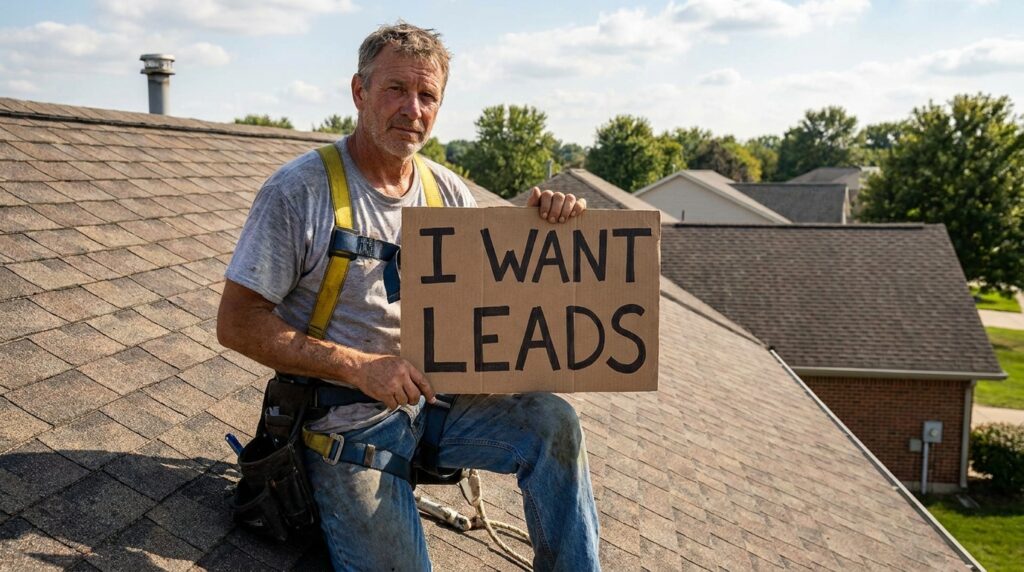
Let’s be direct. The average roofing contractor who struggles with commercial roofing lead generation isn’t struggling because they’re bad at their job. They’re struggling because commercial and residential marketing are completely different animals — and most contractors use the same playbook for both.
Residential buyers are emotional and fast. A homeowner spots a water stain on the ceiling, panics, and calls the first number they find. Commercial buyers — property managers, facility directors, real estate asset managers — are systematic and slow. They’ve got budgets to justify, boards to satisfy, and three competing quotes to gather. They research for weeks before talking to anyone. That means your commercial roofing lead generation system needs to be present during that research phase — not just at the moment they’re ready to call.
The biggest mistakeRunning Facebook ads with urgency messaging (“Storm damage? Call now!”) for commercial accounts. That’s residential psychology applied to commercial buyers. It doesn’t work. Property managers aren’t scrolling Facebook for vendors — they’re Googling specific problems and checking LinkedIn. Be where the money actually is.
The good news? Because most of your competitors are making this mistake, the commercial space online is wide open. A well-built commercial roofing lead generation strategy will outperform competitors with three times your budget — simply because yours is aimed at the right buyer, in the right place, at the right time.
H2
The Commercial Roofing Lead Generation Funnel: Understanding the Buyer Journey
Before you spend a dollar on marketing, you need to understand the three stages every commercial roofing buyer moves through. Your commercial roofing lead generation system needs to have assets and touchpoints at every stage — not just the bottom.
Stage 1 — Awareness
(they have a problem, not yet looking for you)
A property manager notices bubbling on the membrane. They Google “how long does TPO roofing last” or “commercial flat roof inspection checklist.”
This is where your blog content, YouTube videos, and educational articles live. You’re not selling — you’re becoming the expert they trust.
Stage 2 — Consideration
(they’re comparing options and vendors)
Now they’re searching “commercial roofing contractor [city]” and “commercial roof replacement cost.”
This is where your service pages, Google Business Profile, and reviews do the heavy lifting. You need to be visible, credible, and clearly commercial-focused.
Stage 3 — Decision
(budget approved, ready to call)
They’ve narrowed it down to two or three contractors. Your project portfolio, case studies, references, and how fast you respond are what close the deal.
Speed to lead is everything — 78% of commercial buyers choose the vendor who responds first.
Most contractors only market at Stage 3.
The smart ones own all three — pulling buyers in early and staying visible all the way to the signed contract.
That’s how the best commercial roofing lead generation systems actually work.
The 6 Best Channels for Getting Commercial Roofing Leads in 2025
Not all roofing leads are created equal. Here’s every channel that actually works for commercial, ranked by long-term ROI based on what top contractors are doing right now.
Local SEO + Google Business Profile
The highest ROI channel bar none. Ranks you for “commercial roofing contractor [city]” searches.
Permanent asset — works while you sleep. Takes 3–6 months to mature.
SEO Content Marketing
Blog posts targeting awareness-stage searches. Builds trust before buyer contact and drives organic roofing leads for years without ongoing spend.
Google Search Ads
Fastest way to appear for commercial keywords today. Expensive but immediate. Best used to generate leads while organic SEO builds momentum.
Trade Referral Networks
HVAC, GC, and electrical partners who walk the same rooftops. Warm referrals with zero ad spend. A $200 referral fee creates loyal lead sources.
LinkedIn Outreach
Direct access to property managers and facility directors. Post project photos weekly and connect with 10 decision-makers per week. Works in 60–90 days.
Targeted Direct Mail
Postcards to commercial property management firms. Under $300 for 300 targeted addresses. Zero inbox competition — abandoned by most competitors.
Local SEO for Commercial Roofing Lead Generation: Your Most Valuable Long-Term Asset
Build commercial-specific service and location pages
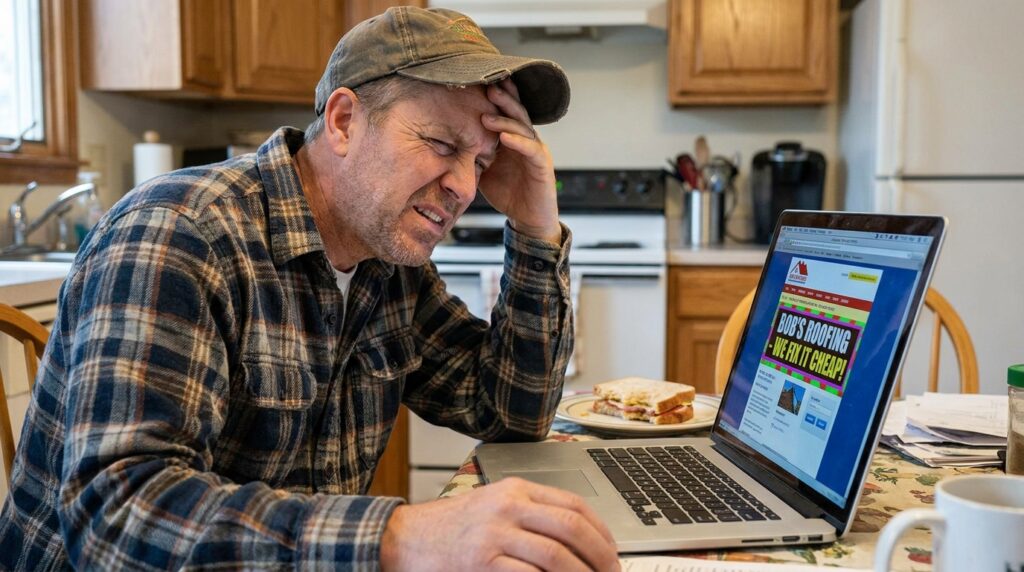
A generic “Services” page won’t rank for anything commercial-specific. You need dedicated pages for every service-location combination: “Commercial Roof Replacement in [City],” “Flat Roof Repair [City],” “TPO Roofing Contractor [City].” Each page needs 600+ words of real information, actual photos of commercial work, and a clear call to action. These pages are the engine of your organic commercial roofing lead generation — and they compound in value every single month.
Maximize your Google Business Profile for commercial searches
Your Google Business Profile is free real estate most contractors waste. Set your primary category to “Roofing Contractor.” Add “commercial” explicitly in your business description. Upload 15–20 photos of actual commercial projects — warehouses, retail strips, flat roofs, before-and-afters. Then actively collect reviews that mention commercial building types. These are direct ranking signals that push you toward the top of local roofing leads searches.
Build citations on industry directories
Citations are mentions of your business name, address, and phone number (NAP) on directories like Angi, HomeAdvisor, the Better Business Bureau, and roofing industry sites. Consistent NAP across 40+ directories is a trust signal Google uses to validate local businesses. For commercial roofing lead generation, also list on commercial-specific directories: BOMA member directories, commercial real estate association sites, and local Chamber of Commerce pages.
Content Marketing: The Secret Weapon of Commercial Roofing Lead Generation
Think about what a facility manager does before they call anyone about a roof issue. They Google it. They read about it. They want to understand what they’re dealing with before they invite contractors in. That research phase is your opportunity — and content marketing is how you own it.
Write blog posts and guides that answer the exact questions your commercial buyers are Googling. Not fluffy filler — real, useful information that demonstrates you know roofing at a deep level. This content does two things simultaneously: it drives organic roofing leads through search traffic, and it pre-sells your expertise before you’ve ever spoken to the prospect.
📌 Content topics that rank and convert
“How much does commercial roof replacement cost per square foot?” ·
“TPO vs EPDM: which is better for large commercial buildings?” ·
“Commercial flat roof lifespan: what to expect from every material” ·
“How to write a commercial roofing scope of work” ·
“Signs your commercial roof needs replacing before it leaks” ·
“Commercial roof maintenance checklist for property managers”
How to Get Commercial Roofing Leads With Paid Advertising — Without Wasting Your Budget
Paid ads are a faucet, not a well. The moment you turn off spend, the roofing leads stop. But used strategically while your organic assets build, they’re indispensable. Here’s how to get commercial roofing leads through paid channels without burning money on the wrong traffic.
- Bid on commercial-specific keywords only: “commercial roof repair [city],” “flat roof replacement contractor,” “TPO roofing company near me.” Never bid on just “roofing” — you’ll pay residential prices for residential leads.
- Use negative keywords aggressively. Add “residential,” “house,” “home,” “shingles,” and “DIY” as negatives in every campaign. This alone can cut wasted spend by 30–40%.
- Send ad traffic to a dedicated commercial landing page — not your homepage. A page built specifically for the ad’s keyword converts 3–5x better than a generic homepage.
- Install call tracking before you spend a single dollar. CallRail starts at $45/month. Without it, you’re flying completely blind on which ads generate actual revenue.
- Add retargeting to your paid strategy. Commercial decisions take months. Retargeting ads keep you visible to site visitors during the entire 3–6 month decision window — for pennies per impression.
The Offline Tactics That Generate Commercial Roofing Leads Faster Than Any Algorithm
Digital is essential but slow. If you need how to get commercial roofing leads in the next 30 days while your SEO builds momentum, offline and relationship strategies are your fastest path to the phone ringing.
The referral trade network is the most underused asset in this business. HVAC contractors, commercial electricians, plumbers, and general contractors walk on commercial rooftops constantly. They see failing seams, standing water, and degraded membrane — and their clients trust them. A simple referral agreement with a $150–$250 fee per closed job turns these relationships into a consistent stream of warm roofing leads. One good HVAC partner can send you three to five commercial jobs a year with zero additional effort.
LinkedIn deserves its own section here. Every facility director, property manager, and commercial real estate owner your company wants to serve has a profile. They’re active. They’re reachable. Connect with 10–15 in your metro area every week. Post one commercial project photo per week with a brief, honest caption about the problem you solved. In 90 days you’ll be the recognizable roofing expert in your professional network — and recognizable is everything when budget gets approved and it’s time to call someone.
🔍 Permit monitoring — the secret nobody talks about
When a commercial property pulls a renovation or construction permit, a roofing decision often follows within 6–18 months.
County assessor records and platforms like BuildZoom list these permits publicly.
Check your county weekly, note the property management companies behind renovation projects, and reach out proactively.
This is pipeline before the pipeline exists — and almost no competitor is doing it.
Speed to Lead: The Part of Commercial Roofing Lead Generation That Kills More Deals Than Bad Marketing
You could have the best commercial roofing lead generation system on the planet — but if you take 24 hours to respond to an inquiry, you’ve handed that job to whoever called back first. Research consistently shows that B2B buyers who don’t hear back within an hour are significantly more likely to choose a competitor. Within two hours, your odds drop dramatically.
Set up automated text confirmation the moment someone submits a contact form. Something like: “Thanks for reaching out — [Your Name] from [Company] will call you within the hour.” That single message keeps them from calling the next contractor on the list. Follow it with a real call, then a professional proposal — not a handwritten estimate on a clipboard. A PDF proposal with your logo, project scope, timeline, materials spec, and three comparable commercial references signals to a property manager that you operate at their level.
Speed plus professionalism is how you convert roofing leads into signed contracts — and it’s the part of the funnel most contractors completely ignore once they’ve finally solved the lead flow problem.
Your 90-Day Commercial Roofing Lead Generation Launch Plan
Here’s the exact sequence that moves the needle without overwhelming you. Execute this in order and you’ll have a functioning commercial roofing lead generation machine inside three months.
- Days 1–10:Audit and fully optimize your Google Business Profile. Upload 15+ commercial project photos. Ask your last 4 commercial clients for a Google review — ask them to specifically mention the building type and size.
- Days 11–20:Build or rebuild your commercial services section. Create individual pages for each core service (flat roof, TPO, EPDM, repair, maintenance contracts). Each needs 600+ words, real content, and a CTA above the fold.
- Days 21–30:Create your first two SEO blog posts targeting awareness-stage questions. Publish them. Share them on LinkedIn with a brief personal note about why you know this topic.
- Days 31–45:Launch a targeted Google Ads campaign. Start with $25–$40/day. Target commercial-specific keywords only. Install call tracking before spending anything.
- Days 46–60:Identify and contact 3 trade partners (HVAC, GC, or electrician) about a mutual referral arrangement. Keep it simple — a handshake deal and a referral fee is all you need to start.
- Days 61–90:Publish two more content pieces. Start attending one local commercial real estate or property management networking event monthly. Send one direct mail campaign to 250 commercial property management companies in your service area.
Three months. Most competitors won’t commit for three weeks. That consistency gap is where your commercial roofing lead generation advantage lives — not in having a bigger budget, but in executing a better system longer than everyone else is willing to.
You now have a complete answer to how to get commercial roofing leads at every stage of the funnel. The system is built. The only variable that matters now is whether you execute it — and the contractors who do are the ones signing the six-figure commercial contracts while everyone else wonders where their next job is coming from.